Display Checkout
We have interactive displays available for your classroom or community events, available for checkout free of charge. Email us if you’re interested in a display.
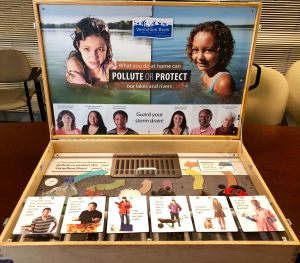
The VRWJPO maintains the Pollute or Protect Exhibit-on-a-Box which features a museum-quality, hands-on display that demonstrates non-point source pollution topics.
The Pollute or Protect Exhibit-in-a-Box displays home solutions for pollution prevention from trash, leaves, grass, salt, dirt, pet waste, and oil. Bringing the ideas to life, an example of each material is displayed, and flip-up cards encourage interaction with the information. It also includes a storm drain flip-up revealing a visual of storm water flowing from “street to stream.”
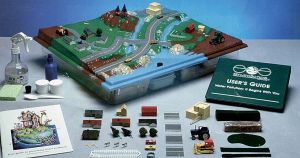
The model represents a watershed that includes several land uses. A lake starts out clean, but as it rains, pollution is washed downstream to contaminate the lake.
Agricultural areas
Lesson: Sediment, fertilizer, and pesticides easily run off when buffers are not in place.
Industrial
Lesson: Industrial areas can be sources of pollution when they are not managed correctly.
Residential
Lesson: Exposed soil easily washes off construction sites, use tools to reduce the erosion. Grass clippings introduce excess phosphorus into downstream water bodies. Sweep, compost, or properly dispose of them.
Forests
Lesson: Trees have deep roots that stabilize steep slopes. When these trees are cut down erosion is more likely. Make sure when a tree is cut down a new one is planted!
Roads
Lesson: In the winter, salt is applied to roads to melt ice. Salt in water bodies suffocates plants and animals that are not used to high salt levels. Don’t use salt on your property, and encourage others to use best practices for snow and ice removal.
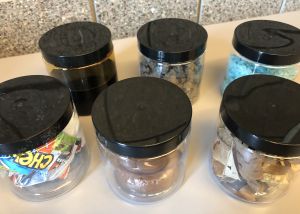
The Pollution Jars interactive display shows different pollutants that may affect our waters. The jars come in their own carrying case.
Trash
Lesson: Make sure trash doesn’t blow out of your garbage bin on the curb. Seal trash bags to keep litter out of the street.
Chemicals
Lesson: Keep your car regularly maintained so fluids won’t leak into the street. Take used motor oil and other household chemicals to the Dakota County Recycling Zone.
Pet Waste
Lesson: Pet waste carries harmful bacteria. Pick up after your pet.
Yard Waste
Lesson: Leaves, grass, and soil feed algae and turn lakes and rivers green. Keep them off sidewalks and streets.
Sidewalk Salt
Lesson: One teaspoon of sidewalk salt permanently pollutes 5 gallons of water. Use it sparingly.
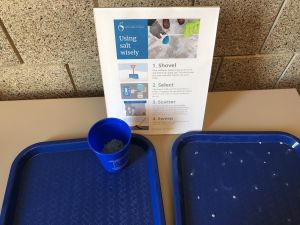
Salt can make sidewalks and roadways safer, but it also pollutes lakes and rivers, harms pets and wildlife, and corrodes buildings, cars, and bridges. The Smart Salting interactive display demonstrates how to properly scatter winter de-icing salt. One tray has salt already scattered in the correct pattern, the other is ready for the user to try their hand at scattering salt with 1-2 inches between each particle. They may be surprised at how little salt is needed.
Shovel
Lesson: Clear walkways before snow turns to ice and before you apply salt. The more snow you clear manually, the less salt you’ll need.
Select
Lesson: Salt doesn’t melt ice if the pavement is below 15 degrees, so use sand for traction when it’s too cold, or choose a different de-icer.
Scatter
Lesson: Use salt only where it’s critical. When you apply salt to pavement, leave plenty of space between granules. A 12-ounce coffee cup of salt is enough to cover 10 sidewalk squares or a 20-foot driveway.
Sweep
Lesson: Clean up leftover salt, sand, and de-icer to save and reuse as needed.
*Adapted from CleanWaterMN.org
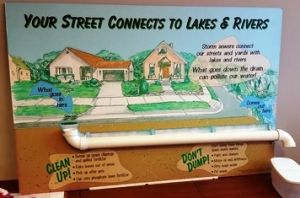
The Your Street Connects to Lakes and Rivers interactive display demonstrates how storm sewers connect our streets and yards directly with local lakes and rivers. This flat, illustrated panel sits on an easel and provides reminders of what not to dump down the storm drain and simple solutions on how we can all make a difference in keeping our local water bodies clean.
Lesson: Don’t dump chemicals down the storm drain. Take used motor oil and other household chemicals to the Dakota County Recycling Zone.
Lesson: Pick up pet waste and dispose of it in the trash or down the toilet.
Lesson: Sweep up leaves, grass, and fertilizer off the sidewalks and streets. Compost leaves and grass clippings or use them as mulch.
Lesson: Use phosphorus-free fertilizer. Phosphorus turns water green with algae. It’s also the law.
Lesson: What goes down the drain can pollute our water.
Other Resources
Metro Area Children’s Water Festival
VRWJPO supports the Metro Area Children’s Water Festival, an annual event for fourth graders in the Twin Cities Metro Area. The festival teaches students about water resources and ways to protect them. Students visit hands-on learning stations staffed by environmental experts, attend a Science Museum of Minnesota presentation, and enjoy the Water Arcade. The in-person festival is usually held the last Wednesday in September at the Minnesota State Fairgrounds. A free virtual festival is free and available all year round. Teachers need to register for the opportunity to participate in-person. The Festival website explains how to register your class, sponsor the festival, or volunteer at one of the learning stations.
Watershed Game
VRWJPO owns a copy of the Watershed Game, created by the University of Minnesota Sea Grant. The game is geared towards community leaders to simulate the decision-making process of protecting a local stream, with financial limitations built in. Contact us if you’re interested in using the game.
Project WET
Project WET (Water Education for Today) is an international, interdisciplinary, water-science education program used by a variety of water users. It is estimated over 20,000 Minnesotans annually use the Project WET resources in a variety of ways, complementing other watershed programming. This hands-on program is administered through the Minnesota Department of Natural Resources.
Printable Kids’ Activities
Hamline University
The Hamline University Center for Global Environmental Education provides a series of digital lessons about stormwater stewardship and how our waterways connect to the seas. Whether for classroom or virtual learning, these can help kids find things they can do to protect water.